
Authors: David Mortlock, Britt Mosman, and David Levine
On Monday, November 16, 2026, the U.S. Department of Commerce’s Bureau of Industry and Security (“BIS”) released an interim final rule,[1] “Addressing Remote Access to Advanced Semiconductors” (the “Remote Access IFR,” or the “rule”),[2] that for the first time squarely targets the use of overseas data centers to give companies in countries of concern remote access to U.S.-controlled computing power. The rule also adds a license requirement for five countries that BIS views as high diversion risks, narrows the pathways available to foundries and packagers of advanced logic chips, and formally rescinds the Biden-era AI Diffusion Rule.
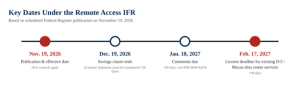
The rule is scheduled for publication in the Federal Register on November 19, 2026, and takes effect on that date. The clock will then start on several deadlines, most importantly a 90-day window for data centers already providing significant compute to companies headquartered in China, Macau, or other Country Group D:5 destinations[3] to obtain a license if they wish to continue those services.
What does the rule do?
The Remote Access IFR amends the Export Administration Regulations (“EAR,” 15 C.F.R. Parts 730-774) in four key areas:
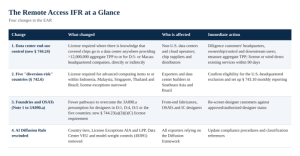
- First, it imposes a new end-use control on exports, reexports, and transfers of advanced chips (which the rule now calls “Super Intelligence” or “SI” items)[4] to data centers, wherever located, that provide significant volumes of compute to D:5- or Macau-headquartered companies (see Section 1 below).
- Second, it requires a license for exports of advanced computing items to Indonesia, Malaysia, Singapore, Thailand, and Brazil, subject to an exclusion for U.S.-headquartered recipients that comply with a new monthly reporting requirement (see Section 2 below).
- Third, it narrows the ways in which front-end fabricators and outsourced semiconductor assembly and test (“OSAT”) companies can overcome the presumption that an advanced logic chip is a controlled 3A090.a item (see Section 3 below).
- Finally, it formally rescinds the AI Diffusion Rule, including the country tiers, the model weights controls, License Exception AIA, License Exception LPP, and the Data Center Validated End-User (“VEU”) authorization (see Section 4 below).
What does this mean for impacted companies?
Cloud and data center operators outside the United States, chip designers and distributors, foundries and OSATs, and companies with supply chains running through Southeast Asia or Brazil should assess their exposure now. The rule shifts significant diligence burdens onto data centers and their suppliers: a data center that declines or is unable to share its know-your-customer information is a red flag that presumptively gives the supplier “knowledge” of a prohibited end use. Affected companies should also consider using the comment period to seek clarification of the rule’s key terms and thresholds.
1. New Data Center End-Use Control (New Section 744.24)
a. Context
As we noted when BIS expanded its advanced computing controls in October 2023,[5] BIS has long been concerned that Chinese companies were effectively “renting” controlled chips from foreign cloud providers, thus removing any need for physical access or an export license. The Remote Access IFR now establishes a standalone end-use control aimed squarely at this end run.
b. Scope of the new control
New Section 744.24(a)(1) prohibits the unlicensed export, reexport, or transfer (in-country) of advanced computing items that are subject to the EAR where there is “knowledge” that the item is destined to a data center, anywhere in the world, that is providing or will provide access to more than 12,000,000 “aggregate TPP” (total processing performance) to or for companies headquartered in, or whose ultimate parent company is headquartered in, Macau or a Country Group D:5 destination.[6]
In practice, data centers and their suppliers will need to conduct, document, and regularly refresh fairly deep customer diligence to be confident that they are not violating the prohibition.
Several features of the control broaden its reach:
- Linked data centers. The threshold can be met at a single data center or across “linked data centers,” defined to include data centers sharing resources, balancing workloads, and replicating data as a unified whole through digital, and not only physical, networking infrastructure.
- Indirect access. The term “for an entity” reaches cases in which a data center provides remote access to a non-D:5 customer that is in turn training SI models for, participating in the training of SI models for, or providing SI models to a D:5 company.
- Downstream holders. The prohibition applies regardless of whether the person in possession of the item was a party to the original export.
- No de minimis relief. The prohibition applies even where a U.S.-origin item has been incorporated into or commingled with a foreign-made item, and reexporters may not rely on the de minimis rules where there is knowledge at any point in the chain of a prohibited end use.
- Changes in end use. Notably, a data center that later (i.e., subsequent to initial diligence and the export/reexport/transfer transaction) begins serving D:5 or Macau companies above the threshold is treated as making a “transfer (in-country)” requiring authorization.[7] For exports made without a license on or after the rule’s effective date, the exporter must notify the recipient of this authorization requirement and of the know-your-customer guidance in supplement no. 3 to part 732.
- Below-threshold activity is not automatically safe. As a conforming change, the rule moves the existing headquarters-based license requirement back into § 744.23(a)(3)(i)(A). BIS also restates that this control is not limited to D:5- or Macau-headquartered entities as consignees or end users, but reaches exports made on their behalf, for example, where such an entity is the purchaser (directly or indirectly) or the exclusive or primary (greater than 50 percent of total compute) remote end user of a data center. That control has no compute threshold, and BIS encourages parties to evaluate both § 744.23 and § 744.24.
c. Diligence expectations
New Note 3 to Section 744.24(a)(1) sets out BIS’s diligence expectations with respect to the prohibitions and license requirements of the rule. To show that they lack “knowledge,” suppliers are expected to obtain, and be able to produce, sufficient information about the foreign data center’s know-your-customer checks, including diligence as to whether any customer is directly or indirectly owned or controlled by D:5 or Macau persons.[8] BIS explains that this diligence is intended to prevent circumvention through corporate restructurings or spinoffs. Where a data center declines or is unable to provide this information, BIS will presume that the supplier has “knowledge” of a prohibited end user unless the red flag is resolved before the transaction proceeds.[9]
Practically, this means that data centers themselves will need to accomplish, and regularly refresh, significant diligence on their customers (or even their customers’ customers) in order to maintain access top-end U.S.-designed chips from reputable suppliers. And suppliers will need to diligence both the data centers themselves and those data centers’ diligence processes. Both data centers and suppliers will need to maintain well-documented records of their diligence processes in order to demonstrate ongoing compliance.
d. Exceptions, licensing policy, and transition
No license exceptions are available to overcome the prohibition unless BIS states otherwise. The rule does, however, exclude computing power provided only for a “commercial recommender system,” defined as an SI tool exclusively designed and exclusively used to rank, filter, or suggest commercial products, services, or content (such as those used by online retailers and social media companies). The definition of “commercial recommender systems” expressly excludes any system that generates novel text, image, audio, video, software, or other content, even if it also performs recommendation functions. To rely on the exclusion, a party must submit to BIS the name of the D:5- or Macau-headquartered company, the aggregate TPP provided to it, and the diligence performed; BIS will share this information with the End-User Review Committee.[10]
License applications under § 744.24 will be reviewed on a case-by-case basis. BIS may also impose license requirements on specific persons or destinations through “is informed” notices. Data centers that were providing significant compute to D:5 or Macau companies before publication of the Remote Access IFR must obtain a license within 90 days of the rule’s effective date or potentially face future export restrictions. BIS also encourages any entity in violation of the existing end-use requirements to submit a voluntary self-disclosure.
2. New License Requirement for Five “Diversion-Risk” Countries
The Remote Access IFR replaces the AI Diffusion Rule’s worldwide Regional Stability license requirement with a narrower set of destination-based controls. Under revised Section 742.6(a)(6)(iii)(A)(1), a license is now required to export, reexport, or transfer advanced computing items to or within Indonesia, Malaysia, Singapore, Brazil, and Thailand, which BIS considers to present a higher-than-normal risk of diversion. Applications will be reviewed case by case, taking into account the effectiveness of each destination’s export control regime and its cooperation with BIS on enforcement. The Secretary of Commerce may designate additional countries, and BIS warns that it may impose consequences such as import restrictions, Entity List designations, and downgrades in export control status on countries that tolerate evasion.
This license requirement does not apply to ultimate consignees or end users headquartered in the United States, or whose ultimate parent company is headquartered in the United States, provided the exporter complies with the new Section 743.10. That section requires monthly reports, due by the first business day of the month after the transaction, that identify each party and its ultimate parent, the ultimate destination and end users, the ECCN (at the paragraph level), product name and SKU, TPP and quantity of each product, and the date of export. The rule also extends the Section 740.2(a)(9)(ii) restrictions on license exceptions to these five destinations, leaving only a short list of exceptions (such as License Exception ACM) available.
The existing license requirement for Country Groups D:1, D:4, and D:5 (other than destinations also in Country Groups A:5 or A:6) remains in place, and is extended to the United Arab Emirates to the extent provided in BIS’s July 2026 UAE rule, except where all recipients are approved UAE entities.[11] The rule also preserves the case-by-case review policy for chips with a TPP below 21,000 and total DRAM bandwidth below 6,500 GB/s destined to end users located in China or Macau, provided the applicant supplies the additional information required by supplement no. 2 to part 748, a policy BIS announced in January 2026.[12] All other applications involving D:5 or Macau destinations or headquartered entities remain subject to a presumption of denial.
3. Tighter Presumptions for Foundries and OSATs
The rule amends paragraphs b. and c. of Note 1 to ECCN 3A090.a so that front-end fabricators and OSATs can no longer use those pathways to overcome the presumption that an “applicable advanced logic integrated circuit” is a 3A090.a item where the chip designer is located in, or has an ultimate parent headquartered in, Country Group D:1, D:4, or D:5, or one of the five countries discussed above. Unless such designers are approved or authorized IC designers, their chips are presumed to be 3A090.a items and therefore subject to the licensing requirements discussed above, among others. New § 744.23(a)(3)(i)(C) also requires a license, for any destination, when a front-end fabricator or OSAT exports 3A090.a advanced logic ICs designed by a company that is neither an approved nor an authorized IC designer.
4. Formal Rescission of the AI Diffusion Rule
When BIS announced in May 2025 that it would not enforce the AI Diffusion Rule, it left the underlying regulatory text in place, which created considerable uncertainty. The Remote Access IFR formally rescinds that text by removing the country tiers, License Exception AIA (§ 740.27), License Exception LPP (§ 740.29), the Data Center VEU authorization and related supplements, and the controls on AI model weights (ECCN 4E091, together with the associated foreign direct product rule and red flag). BIS has retained the worldwide scope of the advanced computing foreign direct product rule in § 734.9(h) and License Exception ACM. BIS also states that it keeps jurisdiction over a § 734.9(h) chip after the chip is incorporated into a foreign-produced board or server.[13]
A savings clause allows shipments that lose license-free or license exception eligibility under the rule, and that were en route on the date of publication, to proceed if they are completed within 30 days of publication (i.e., by December 19, 2026).
5. Forward-Looking Assessment
The Remote Access IFR is the replacement framework that industry has been waiting for since the AI Diffusion Rule was abandoned, although it is considerably narrower than its predecessor. Instead of a worldwide licensing scheme with country tiers, BIS has chosen targeted destination controls combined with an expansive end-use control. It is also BIS’s most direct response so far to the cloud-access problem that has been repeatedly flagged by analysts and policymakers (and, to be fair, by BIS itself). The rule regulates the export of chips to data centers and not the provision of remote access as such, but it achieves a similar result by making suppliers and data center operators responsible for knowing whose workloads the chips serve.
In practice, compliance will depend on diligence. The 12,000,000 aggregate TPP threshold, the treatment of digitally linked data centers, the coverage of indirect access through intermediaries, and the presumption of knowledge where a data center withholds customer information will require suppliers and operators to establish new contractual information rights, certifications, and monitoring. The rule also continues a theme from BIS’s January 2026 rule: a willingness to allow commercial activity while relying more heavily on verification and the increased threat of enforcement.[14] Companies with operations in the five newly designated countries should expect closer scrutiny, and the Secretary of Commerce may designate additional destinations.
What companies should do now
- Inventory current and pipeline customers headquartered, or ultimately owned or controlled, in D:5 or Macau, including those reached through intermediaries.
- Measure aggregate TPP for each relationship across all linked data centers.
- Decide whether to license, restructure, or wind down existing covered arrangements.
- Update diligence and contracts to add headquarters and ownership representations, end-use certifications, resale and flow-down restrictions, and audit and termination rights.
- Confirm § 743.10 reporting procedures for shipments to the five designated countries and consider submitting comments by January 18, 2027.
We encourage companies with affected operations to participate in the comment process and to contact the Willkie attorneys listed below with any questions about the Remote Access IFR.
Click here to download this article.
[1] Unusually, BIS’s announcement (see https://media.bis.gov/sites/default/files/documents/BIS%20Issues%20Rule%20Addressing%20Remote%20Access%20to%20American%20Super%20Intelligence%20Technology.pdf) noted that the rule was “written by and at the direction of the Department of Treasury and the National Security Council.”
[2] The rule’s prepublication text can be found at https://www.bis.gov/media/documents/rin-0694-ak50.pdf. The rule is scheduled for publication on November 19, 2026 as FR Doc. 2026-23529 (Docket No. 261116-0005), https://www.federalregister.gov/d/2026-23529.
[3] Country Groups are listed in Supplement No. 1 to 15 C.F.R. Part 740; https://www.bis.gov/regulations/ear/740#supplement-1-740.
[4] Pursuant to Executive Order 14434, Inaugurating the Era of Super Intelligence, the rule uses the terms “Super Intelligence” and “SI” in place of “Artificial Intelligence” and “AI.”
[5] https://www.willkie.com/-/media/files/publications/2023/11/us_expands_year_old_semiconductor_export_controls_with_additional_controls_on_the_way.pdf.
[6] The covered items are those specified in ECCNs 3A001.z; 3A090 (except 3A090.c); 4A003.z; 4A004.z; 4A005.z; 4A090; 5A002.z; 5A004.z; 5A992.z; 5D002.z; 5D992.z; and related software and technology in 3D001, 3E001, 4D001, 4D090, 4E001, 5E002, and 5E992. “Aggregate TPP” is newly defined in § 772.1 as the sum of the total processing performance of all covered integrated circuits (“ICs”) or commodities in a group.
[7] Note that this treatment is not inconsistent with the EAR’s definition of “transfer”— “a change in end use or end user of an item within the same foreign country” (15 C.F.R. § 734.16)—to the extent providing data center access to a non-D:5 company could be considered a different “end use” from providing those same services to a D:5-based company.
[8] Note that this means not only that suppliers will be expected to carry out this diligence on their data center customers, but that the data centers themselves will need to undertake this diligence of their own end users if they want to retain access to products provided by legitimate suppliers.
[9] An obligation to resolve the “red flag” is not theoretical; Supplement No. 3 to 15 C.F.R. Part 732 creates “a duty to check out the suspicious circumstances and inquire about the end-use, end-user, or ultimate country of destination. The duty to check out ‘red flags’ is not confined to the use of License Exceptions affected by the ‘know’ or ‘reason to know’ language in the EAR.” (Supplement No. 3 to 15 C.F.R. Part 732, para. (a)(2)).
[10] The Remote Access IFR states that “‘commercial recommender systems,’ such as those used by online retailers and social media companies . . . do not pose the same national security threat [as other SI systems],” but it is unclear the extent to which BIS will take a company’s word that its use of SI is, in fact, “exclusively designed and exclusively used to rank, filter, or suggest commercial products, services, or content.” Given public debates over the national security effects of social media, it is possible that BIS will offer additional guidance on this carve-out going forward.
[11] “Enhanced Favorable Treatment for the United Arab Emirates Under the Export Administration Regulations,” 91 Fed. Reg. 43034 (July 14, 2026).
[12] See https://www.willkie.com/-/media/files/publications/2026/01/bis-paves-the-way-for-chip-exports-to-china-while-privileging-domestic-investment.pdf.
[13] BIS reasons that, because ECCN 4A090 and the .z entries cover only items that contain an ECCN 3A090 IC, third parties that receive those items are on notice that they contain a controlled chip.
[14] See, e.g., BIS’s increased enforcement assets discussed in Section III of https://www.willkie.com/-/media/files/publications/2026/09/time-for-exporters-to-evaluate-their-screening-capabilities.pdf.
